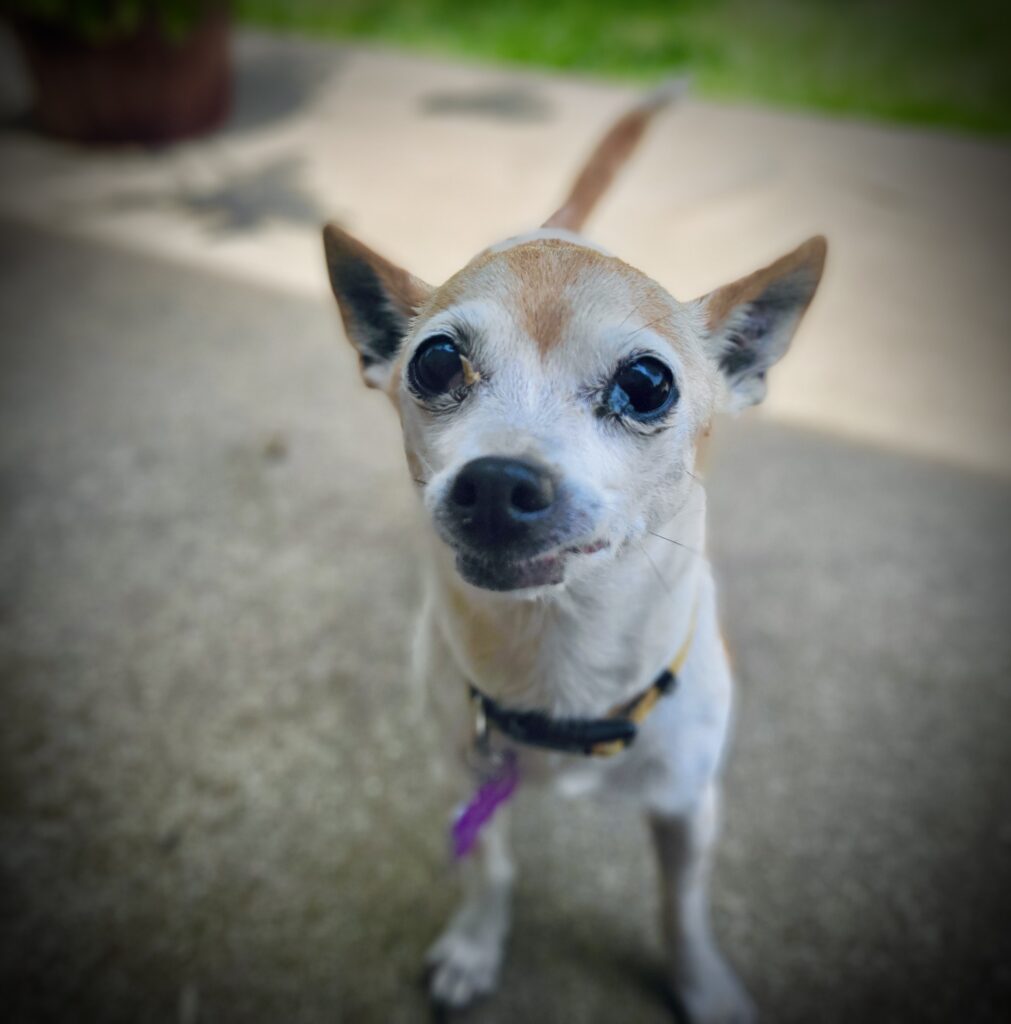
anxiety, misunderstood
“Our emotional state does not stop at the boundary of our skin. While we are trying to understand what our dog’s nervous system is telling us, they may already be listening closely to ours.”
Recognizing the subtle signs of stress, overwhelm, and the quiet communication happening in both directions.
When most people picture an anxious dog, they picture something obvious: trembling during a thunderstorm, hiding beneath the bed, whining when their person leaves, or desperately trying to escape from fireworks.
And yes, anxiety can look like all of those things. But sometimes it looks like a dog who suddenly won’t sit when you ask, who barks or pulls on leash, paces around the house, follows you from room to room, destroys something while you’re gone, or refuses to walk through a doorway they walked through yesterday.
Sometimes the dog we call stubborn is overwhelmed. The dog we call hyper can’t settle. The dog we call dramatic is frightened. And sometimes a dog who appears to be doing very little is communicating quite a lot.
Dogs can’t tell us, “Something about this situation doesn’t feel safe to me.” They tell us with behavior. Our job is learning how to listen.
Fear, Stress and Anxiety Aren’t Exactly the Same Thing
We tend to use these words interchangeably, but there are useful distinctions.
Fear generally describes a response to something perceived as an immediate threat: thunder happening right now, an unfamiliar dog approaching, or someone reaching toward the animal.
Anxiety is more anticipatory. The nervous system begins preparing for something unpleasant before it actually happens. Research in canine behavior similarly distinguishes fear of an immediate danger from anxiety associated with anticipating a future threat.
Stress is broader still, describing the physiological and behavioral response to demands placed on the animal.
Naturally, these states overlap. A dog frightened badly enough by thunderstorms may eventually begin showing anxiety before the storm arrives because changes in pressure, wind, light, or other environmental cues have started predicting what comes next.
Dogs are very good at learning what predicts good things. They are equally capable of learning what predicts frightening ones.
Anxiety Isn’t Always Dramatic
One of the most important things we can learn about canine body language is that distress doesn’t have one universal appearance.
In a study examining dogs’ responses to common household noises, researchers observed behaviors including retreating, pacing, trembling, hiding, panting, barking, lunging, proximity-seeking, tucked ears, lip licking, and freezing. Researchers also found that many owners appeared to underestimate their dogs’ fear, particularly when the sounds were ordinary household noises rather than obvious events such as fireworks.
Some of those behaviors are especially easy to misread. A barking or lunging dog may look bold. A dog running wildly around a room may look excited. A dog climbing into your lap may simply seem affectionate. A dog refusing to move may appear stubborn.
That is why body language has to be read in context. Rather than asking, “What does this behavior mean?” it is often more useful to ask, “What is happening around this dog when the behavior occurs?”
The Quieter Vocabulary of Stress
Some dogs broadcast discomfort. Others whisper it.
Changes worth noticing can include repeated lip licking when food isn’t present, turning the head or body away, lowering the body, holding the ears back, carrying the tail unusually low, panting without an obvious reason, pacing, trembling, hiding, becoming unusually clingy, refusing food, freezing, or simply becoming unable to settle.
Lip licking, for example, has been studied as one of several behaviors dogs may display during uncomfortable social interactions. But one lip lick does not diagnose anxiety, just as one yawn doesn’t. Dogs lick their lips because they ate something. They yawn because they’re tired. They pant because they’re hot.
Individual behaviors aren’t secret codes with one fixed translation. Look instead for clusters, changes, and context. What happened just before the behavior? Are several stress-related signals appearing together? Does the behavior disappear when the dog gets more distance? Does it reliably happen around a certain person, dog, object, environment, or sound?
Most importantly, ask whether the behavior is normal for this particular dog. Patterns tell us much more than isolated gestures.
Sometimes Anxiety Looks Like Excitement
High arousal isn’t synonymous with happiness.
Think about your own nervous system. Your heart rate might rise because you’re thrilled, or because you’re terrified. From the outside, arousal alone doesn’t tell us which one.
Dogs can present the same challenge. A barking, jumping, spinning dog may indeed be delighted, while another dog displaying very similar activity may be struggling to regulate themselves.
So look beyond the activity itself. What does the rest of the body look like? Can the dog disengage from whatever has their attention? Can they respond to familiar cues? Do they recover quickly once the stimulus disappears, or does their nervous system seem stuck on high alert?
Sometimes, instead of immediately deciding, “He’s so excited,” it’s worth asking whether he is actually comfortable.
Sometimes Anxiety Looks Like Affection
This one is especially easy to romanticize.
A dog who suddenly glues themselves to your leg may simply want affection, but increased proximity-seeking can also be a coping response during stress. Research on dogs exposed to household noises found that many sought closeness with their people when frightened.
So if your normally independent dog suddenly follows you from room to room while construction is happening next door, that change is worth noticing.
And if your frightened dog comes looking for you, comforting them does not somehow “reward fear” in the simplistic sense sometimes suggested in older training advice. Fear is an emotional state, not a trick the dog is performing for reinforcement.
If your dog comes to you because you feel safe, be safe. That doesn’t mean panicking with them. It means being steady, offering somewhere to retreat, reducing unnecessary demands, creating distance when possible, and allowing them access to the person they trust.
Sometimes Anxiety Looks Like Stubbornness
Imagine you’re walking with your dog and suddenly they stop.
You ask them to move forward. Nothing. You cue them again. Still nothing. The leash gets a little tighter and frustration begins creeping in: Why are you being difficult?
But look at the dog before deciding what the behavior means. Where are their ears? Where is their tail? Has their body weight shifted backward? Are they scanning the environment? Is there construction ahead, a strange object, a barking dog behind a fence, or a surface they don’t trust?
I’ve personally experienced dogs who do this because they think it’s time for a treat. When they do this with their guardian, who is ready to keep them moving, they get one. Or perhaps they’re hurting. A refusal isn’t automatically anxiety, but it isn’t automatically defiance either. This is exactly why I prefer working from curiosity instead of obedience. Behavior gives us information before it gives us a problem to solve.
Sometimes Anxiety Looks Like “Nothing”
One of the easiest canine responses to miss is freezing.
Humans tend to notice fight and flight because they’re active and obvious. Stillness can be much easier to interpret as cooperation.
A dog who suddenly becomes rigid during handling isn’t necessarily “being good.” A dog lying perfectly motionless while a child climbs over them isn’t necessarily enjoying the interaction. A dog who stops resisting restraint isn’t automatically relaxed.
Sometimes stillness is precisely the behavior we need to pay attention to.
Research examining whether children and parents could recognize canine distress signals found that education improved people’s ability to interpret those behaviors. That has obvious implications for safer human-dog interactions, particularly around children. The growl isn’t necessarily where communication began. Often, it’s simply where humans finally noticed.
Don’t Punish the Warning System
If a dog growls, my first goal isn’t to make the growling disappear. I want to know why the dog needed to growl. Growling gives us valuable information. It may mean, “I’m uncomfortable,” “you’re too close,” or “please stop.”
If we punish the communication without changing the emotion underneath it, we may create a quieter dog, but quieter does not necessarily mean safer. The dog may still be afraid; we have simply taught them that expressing that fear has consequences.
I’d much rather hear the whisper than wait for the scream.
Anxiety Also Has a Body
None of this is “just behavioral.” Stress is physiological.
When a dog is frightened or overwhelmed, the response can involve changes in heart rate, blood pressure, stress hormones, breathing, muscle tension, and other systems throughout the body. What we see on the outside — pacing, panting, freezing, trembling, clinging, barking — is only part of what is happening.
And that physiology does not exist in isolation.
One fascinating study followed 58 dog-human pairs and measured hair cortisol, a marker of longer-term stress exposure. Researchers found that the dogs’ and owners’ cortisol levels were synchronized across two seasons. The study shows correlation rather than establishing one simple causal pathway, but the relationship was not explained by the dogs’ physical activity or amount of training. The researchers concluded that dogs appear, to a considerable extent, to mirror the long-term stress levels of their humans.
That becomes even more interesting when we look at what dogs can detect directly from us.
Controlled studies have shown that dogs can distinguish human stress-related chemosignals — chemical information released through things like sweat and breath. Exposure to the scent of human fear or stress has been associated with changes in dogs’ heart rate, behavior, and even the way they approach an uncertain situation. In one experiment, dogs exposed to the odor of a stressed person behaved more cautiously when faced with an ambiguous cue.
So when we say a dog is “tuned into us,” that is not merely sentimental language.
Our nervous system changes the body. The body changes what we release into the environment. And dogs, with sensory systems far more sensitive than our own in many respects, are remarkably equipped to notice.
They are also reading our posture, breathing, movement, facial expression, tone, routine, and countless other signals we may not even realize we are giving.
We do not yet know how all of these channels combine, or how much weight a dog gives to one signal over another. But the larger picture is becoming difficult to ignore: dogs are not simply responding to what we consciously say or do. They are responding to the physiological and emotional environment we create around them as well.
Our emotional state does not stop at the boundary of our skin.
And perhaps that is one more reason to approach an anxious dog with curiosity rather than correction. While we are trying to understand what their nervous system is telling us, they may already be listening closely to ours.
Quote excerpt for the top
Before You Call It Anxiety, Consider Pain
There is another side to this conversation that matters enormously: behavior changes can also be medical.
A dog who suddenly doesn’t want to climb stairs may not be afraid of the stairs. A dog who begins snapping when touched may not have developed a “bad attitude.” A dog who becomes restless, clingy, withdrawn, reluctant to sit, unable to settle, or unusually reactive may be experiencing physical discomfort.
This is particularly important when a behavior appears suddenly or seems very unlike the individual dog. Especially with seniors, behavior and body belong to the same animal. A sudden behavioral change deserves curiosity about physical health as well as emotional state.
Learn Your Dog’s Baseline
This may be more useful than memorizing a hundred charts of canine body language: learn your dog.
What does their relaxed face look like? How do they normally carry their ears? Where does their tail naturally sit? How quickly do they settle after excitement? Do they usually follow you everywhere or prefer another room? Do they normally inhale treats or inspect each one like a tiny restaurant critic?
Once you know the baseline, changes become much easier to see. You aren’t comparing your dog with an infographic. You’re comparing them with themselves. That is often where the earliest information lives.
Give Them Somewhere to Go
One of the simplest things we can offer an anxious animal is agency: distance, an exit, a quiet room, a familiar bed, the ability to decline an interaction, or the opportunity to approach something slowly rather than being dragged toward it.
That doesn’t mean avoiding every mildly uncomfortable experience forever. Dogs can learn. Confidence can grow. Fear can change. But learning happens very differently when an animal is capable of processing what is happening than when they are simply trying to escape it.
If your dog can communicate, “That’s too much right now,” and your response consistently demonstrates, “I hear you,” something else is being learned at the same time: trust.
What Happened Before the Behavior?
A dog barked. Pulled away. Froze. Ppaced all night. Couldn’t settle. Refused a familiar cue.
Of course we can ask how to change the behavior, but a few questions are worth asking first: What happened immediately before it? What changed in the environment? What does the rest of the dog’s body tell me? Is this typical for this dog? Could pain or illness be involved? What happens if I give them more distance? And finally: what might my dog be trying to tell me?
Behavior doesn’t arrive out of nowhere. There is an animal underneath it, a nervous system underneath it, and an experience underneath it.
Sometimes the greatest improvement we can make in our dog’s behavior begins not by becoming better at getting them to listen to us, but by becoming better at noticing that they’ve been talking to us all along.
Sources & Further Reading
D’Aniello, B., Semin, G.R., Alterisio, A., Aria, M. & Scandurra, A. (2018). Interspecies transmission of emotional information via chemosignals: from humans to dogs (Canis lupus familiaris). Animal Cognition, 21, 67–78. This experiment tested whether dogs could respond to human body odors collected under fearful and happy emotional conditions, providing evidence that human emotional information can be communicated to dogs through chemosignals.
Grigg, E.K., Chou, J., Parker, E., et al. (2021). Stress-Related Behaviors in Companion Dogs Exposed to Common Household Noises, and Owners’ Interpretations of Their Dogs’ Behaviors. Frontiers in Veterinary Science. Researchers surveyed 386 dog owners and analyzed videos of dogs responding to household sounds, finding both obvious and subtle fear-related behaviors and evidence that owners sometimes underestimated canine distress.
Gähwiler, S., Bremhorst, A., Tóth, K. & Riemer, S. (2020). Fear expressions of dogs during New Year fireworks: a video analysis. Scientific Reports. The study highlights substantial individual differences in the ways dogs express fear and cautions against relying on a single behavioral indicator.
Parr-Cortes, Z., Müller, C.T., Talas, L., Mendl, M., Guest, C. & Rooney, N.J. (2024). The odour of an unfamiliar stressed or relaxed person affects dogs’ responses to a cognitive bias test. Scientific Reports, 14, 15843. Dogs exposed to stress odor from unfamiliar humans showed a more cautious response to an ambiguous cue, even without visual or auditory information from the person, suggesting that human stress odor can influence canine risk perception, cognition, and learning.
Pedretti, G., et al. (2023). Appeasement function of displacement behaviours? Dogs’ behavioural displays in response to threatening and friendly human interactions. This study examined behaviors including lip licking across different social situations and reinforces the importance of reading individual behaviors in context.
Meints, K., Brelsford, V.L. & De Keuster, T. (2018). Teaching Children and Parents to Understand Dog Signaling. Frontiers in Veterinary Science. Researchers found that education improved recognition and interpretation of dogs’ distress signaling.
Sundman, A.-S., Van Poucke, E., Svensson Holm, A.-C., Faresjö, Å., Theodorsson, E., Jensen, P. & Roth, L.S.V. (2019). Long-term stress levels are synchronized in dogs and their owners. Scientific Reports, 9, 7391. Researchers measured hair cortisol in 58 dog-human pairs across two seasons and found significant interspecies correlations in long-term cortisol levels; the dogs’ activity levels and amount of training did not explain the association.
American Veterinary Society of Animal Behavior. Guidance on fearful dogs, humane behavior modification, and the importance of considering fear rather than dominance when evaluating aggressive or defensive behavior.